Shattering the Monolith: jtendo UPF Rides the Wave of Mobile Core Evolution

The User Plane Function (UPF) is the backbone of the 5G Core, but its roots lie in the critical architectural shifts of 4G. As operators move toward high-performance, low-latency networks, understanding the transition from the Evolved Packet Core (EPC) to a disaggregated 5G architecture is essential.
Here is a look at the evolution of Control and User Plane Separation (CUPS) and how the jtendo UPF leverages modern kernel technologies such as eBPF to deliver the performance required for Multi-access Edge Computing (MEC) and network slicing.
Why CUPS Matters
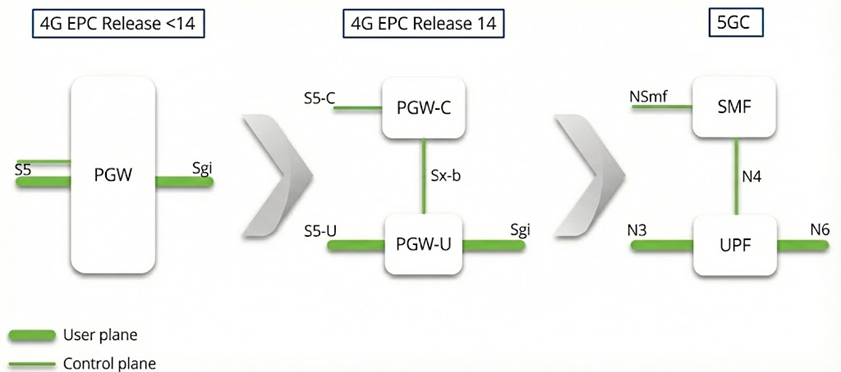
Introduced in 3GPP Release 14, CUPS was the industry’s answer to the limitations of monolithic architectures. In previous releases, the PGW (Packet Gateway) handled both the User Plane (data) and the Control Plane (signaling).
This tight coupling created bottlenecks. CUPS decoupled these functions into:
- PGW-C: Handling signaling and control.
- PGW-U: Handling data forwarding.
The goal was to process data as close to the network edge as possible while keeping control centralized. This shift reduced packet delays, lowered network complexity, and increased bandwidth—paving the way for the true potential of 5G.
Meet the jtendo UPF
The jtendo User Plane Function (UPF) is designed to bridge the gap between the Radio Access Network (RAN) and the Data Network (DN). It is a versatile solution that supports the latest 3GPP Releases, and can be co-located with control nodes or deployed at the edge for rapid data processing.
Key Capabilities
The jtendo UPF is built for flexibility and performance. Its feature set includes:
- Traffic Management: Includes Data Rate Limiting at the session level and traffic usage reporting.
- Flexible Deployment: Runs as a Virtual Network Function (VNF), CNF (Cloud-native Network Function), or on Physical COTS hardware.
- Legacy & Future Compliance: Functions as a UPF, PGW-U, SGW-U, or GGSN-U.
- Interface Support: Full support for 5G interfaces (N3, N6, N9) and EPC interfaces (S1-U, S11, S5, S8).
- Session Management: Handles session management via the standardized PFCP protocol.
- Dual Stack: Full support for IPv4 and IPv6.
- Lawful Interception: Supports Centralized Lawful Interception when paired with jtendo PGW-C.
Performance by Design
- High-Speed Processing: Utilizes eBPF technology for superior packet throughput.
- Kernel Offload: Optimized software path via kernel offload.
- Hardware Acceleration: Supports NIC offload (requires XDP offload support on the NIC device).
The Technology Stack: eBPF and XDP
The secret sauce behind the jtendo UPF’s performance lies in its use of Linux kernel technologies that bypass traditional networking overheads.
1. eBPF (Extended Berkeley Packet Filter)
eBPF is a revolutionary technology that allows programmability within the Linux kernel without changing the kernel source code or loading modules.

Why it matters: In NFV (Network Function Virtualization), eBPF allows the UPF to inspect, filter, and route packets instantly. It is the standard for high-performance real-time packet analysis and security.
2. XDP (eXpress Data Path)
XDP leverages eBPF to process packets at the earliest possible point in the software stack—immediately after the network driver receives them.
The Advantage: By operating just above the device driver, XDP bypasses the heavy TCP/IP stack overhead, enabling ultra-fast packet reception and transmission.
Architecture: Under the Hood
The jtendo UPF architecture is split into three distinct logical units to maximize efficiency and stability:
- The Control Layer: PFCP Server (Rust)
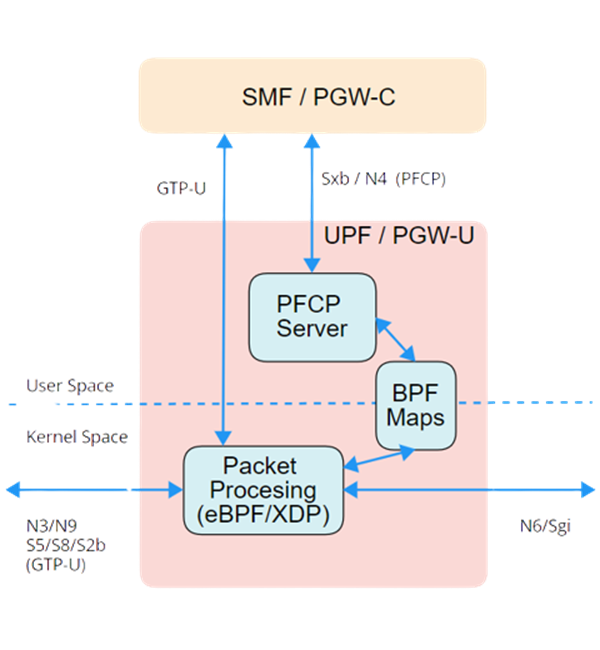
Implemented in Rust for memory safety and concurrency, the PFCP Server runs in User Space.
Action: Based on rules received from the control plane, it updates the BPF Maps.
Role: It exchanges PFCP packets with the SMF (Session Management Function) or PGW-C over a standardized port.
2. The Bridge: BPF Maps
Located between User Space and Kernel Space, BPF Maps act as a high-speed shared database/information bus.
- Role: Stores session information (lookup keys include MSISDN, IMSI, or TEID).
- Action: Allows the Control Layer to push rules down to the Data Plane without interrupting traffic.
3. The Data Plane: Packet Processing Unit (eBPF/XDP)
This unit operates in the Kernel Space (or directly on the NIC via XDP offload).
- Role: High-performance data processing between the RAN and DN.
- Action: It fetches session rules from BPF Maps and executes forwarding, rate limiting, or dropping of packets at line rate.
Summary
As operators transition from EPC to 5G, the demand for high-performance, low-latency networks necessitates a shift away from monolithic architectures. The jtendo UPF addresses this shift by combining the architectural flexibility of Control and User Plane Separation (CUPS) with the raw processing power of modern Linux kernel technologies. By using eBPF and XDP, the solution bypasses traditional networking overhead, delivering the high-throughput required for Multi-access Edge Computing (MEC) and network slicing. Capable of supporting both legacy interfaces and cloud-native 5G deployments, the jtendo UPF provides a versatile, future-proof foundation for next-generation Telco clouds and Mobile Private Networks.